

What Is Migration (Gene Flow) And How Does It Affect The Genetic Makeup Of Populations? Quizlet
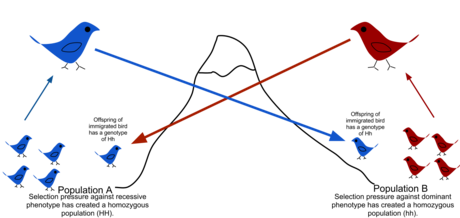
Gene flow is the transfer of alleles from i population to another population through immigration of individuals.
In population genetics, gene flow (likewise known equally cistron migration or geneflow and allele menses) is the transfer of genetic textile from one population to another. If the rate of factor flow is high enough, then two populations volition have equivalent allele frequencies and therefore can be considered a single effective population. It has been shown that it takes only "one migrant per generation" to preclude populations from diverging due to drift.[one] Populations can diverge due to selection even when they are exchanging alleles, if the selection pressure is stiff plenty.[two] [3] Gene flow is an important mechanism for transferring genetic diversity among populations. Migrants alter the distribution of genetic diversity among populations, by modifying allele frequencies (the proportion of members carrying a particular variant of a gene). High rates of cistron flow tin reduce the genetic differentiation between the two groups, increasing homogeneity.[iv] For this reason, gene menstruation has been thought to constrain speciation and prevent range expansion by combining the gene pools of the groups, thus preventing the development of differences in genetic variation that would take led to differentiation and accommodation.[5] In some cases dispersal resulting in gene menstruum may too result in the addition of novel genetic variants under positive selection to the gene pool of a species or population (adaptive introgression.[6])
There are a number of factors that impact the rate of gene flow between different populations. Cistron period is expected to be lower in species that have low dispersal or mobility, that occur in fragmented habitats, where in that location is long distances between populations, and when there are small population sizes.[7] [8] Mobility plays an important role in dispersal rate, every bit highly mobile individuals tend to have greater movement prospects. Although animals are idea to be more mobile than plants, pollen and seeds may be carried great distances by animals, h2o or wind. When factor flow is impeded, at that place can be an increase in inbreeding, measured by the inbreeding coefficient (F) within a population. For example, many island populations have low rates of gene flow due to geographic isolation and pocket-size population sizes. The Black Footed Rock Wallaby has several inbred populations that live on various islands off the coast of Australia. The population is so strongly isolated that lack of factor period has led to loftier rates of inbreeding.[9]
Measuring gene menses [edit]
The level of gene period amidst populations tin can exist estimated by observing the dispersal of individuals and recording their reproductive success.[4] [10] This directly method is but suitable for some types of organisms, more often indirect methods are used that infer gene flow by comparing allele frequencies among population samples.[ane] [4] The more genetically differentiated two populations are, the lower the estimate of gene flow, because gene period has a homogenizing effect. Isolation of populations leads to departure due to drift, while migration reduces divergence. Gene menstruation can be measured by using the constructive population size ( ) and the net migration rate per generation (k). Using the approximation based on the Island model, the effect of migration can exist calculated for a population in terms of the caste of genetic differentiation( ).[eleven] This formula accounts for the proportion of total molecular marker variation among populations, averaged over loci.[12] When at that place is ane migrant per generation, the inbreeding coefficient ( ) equals 0.2. Even so, when there is less than 1 migrant per generation (no migration), the inbreeding coefficient rises rapidly resulting in fixation and consummate departure ( = i). The almost common is < 0.25. This means there is some migration happening. Measures of population structure range from 0 to 1. When factor flow occurs via migration the deleterious effects of inbreeding tin can be ameliorated.[1]



The formula can exist modified to solve for the migration rate when is known: , Nm = number of migrants.[1]

Barriers to gene menstruation [edit]
Allopatric speciation [edit]
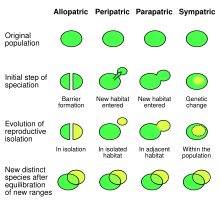
Examples of speciation affecting cistron flow.
When gene flow is blocked by physical barriers, this results in Allopatric speciation or a geographical isolation that does not allow populations of the same species to exchange genetic fabric. Physical barriers to cistron menses are commonly, but non always, natural. They may include impassable mountain ranges, oceans, or vast deserts. In some cases, they can be bogus, homo-made barriers, such equally the Nifty Wall of China, which has hindered the cistron flow of native plant populations.[13] One of these native plants, Ulmus pumila, demonstrated a lower prevalence of genetic differentiation than the plants Vitex negundo, Ziziphus jujuba, Heteropappus hispidus, and Prunus armeniaca whose habitat is located on the contrary side of the Nifty Wall of China where Ulmus pumila grows.[13] This is because Ulmus pumila has wind-pollination as its primary ways of propagation and the latter-plants carry out pollination through insects.[13] Samples of the same species which grow on either side accept been shown to have developed genetic differences, because at that place is little to no gene flow to provide recombination of the cistron pools.
Sympatric speciation [edit]
Barriers to gene menstruum need non ever be concrete. Sympatric speciation happens when new species from the aforementioned ancestral species arise along the same range. This is often a issue of a reproductive bulwark. For example, two palm species of Howea found on Lord Howe Island were found to have substantially unlike flowering times correlated with soil preference, resulting in a reproductive barrier inhibiting factor flow.[fourteen] Species tin live in the same surroundings, yet show very limited gene flow due to reproductive barriers, fragmentation, specialist pollinators, or limited hybridization or hybridization yielding unfit hybrids. A cryptic species is a species that humans cannot tell is dissimilar without the use of genetics. Moreover, gene period between hybrid and wild populations can consequence in loss of genetic multifariousness via genetic pollution, assortative mating and outbreeding. In human being populations, genetic differentiation can too result from endogamy, due to differences in degree, ethnicity, customs and religion.
Human assisted cistron-flow [edit]
Genetic rescue [edit]
Gene flow tin also exist used to assist species which are threatened with extinction. When a species be in small populations in that location is an increased risk of inbreeding and greater susceptibility to loss of diverseness due to migrate. These populations can do good greatly from the introduction of unrelated individuals[x] who tin can increase multifariousness[15] and reduce the amount of inbreeding, and potentially increment population size.[16] This was demonstrated in the lab with ii bottleneck strains of Drosophila melanogaster, in which crosses between the two populations reversed the effects of inbreeding and led to greater chances of survival in not only ane generation but two.[17]
Genetic pollution [edit]
Human activities such as motion of species and modification of landscape can result in genetic pollution, hybridization, introgression and genetic swamping. These processes can lead to homogenization or replacement of local genotypes as a outcome of either a numerical and/or fitness reward of introduced constitute or brute.[18] Nonnative species can threaten native plants and animals with extinction by hybridization and introgression either through purposeful introduction by humans or through habitat modification, bringing previously isolated species into contact. These phenomena tin be especially detrimental for rare species coming into contact with more arable ones which tin occur between island and mainland species. Interbreeding between the species can crusade a 'swamping' of the rarer species' genetic pool, creating hybrids that supplant the native stock. This is a direct effect of evolutionary forces such equally natural selection, likewise as genetic drift, which atomic number 82 to the increasing prevalence of advantageous traits and homogenization. The extent of this phenomenon is not e'er credible from outward appearance solitary. While some degree of gene flow occurs in the grade of normal evolution, hybridization with or without introgression may threaten a rare species' existence.[19] [20] For instance, the Mallard is an abundant species of duck that interbreeds readily with a wide range of other ducks and poses a threat to the integrity of some species.[21] [22]
Urbanization [edit]
There are two main models for how urbanization affects gene menstruation of urban populations. The first is through habitat fragmentation, also called urban fragmentation, in which alterations to the landscape that disrupt or fragment the habitat subtract genetic diversity. The second is called the urban facilitation model, and suggests that in some populations, gene flow is enabled by anthropogenic changes to the landscape. Urban facilitation of cistron catamenia connects populations, reduces isolation, and increases gene period into an area which would otherwise not accept this specific genome composition.[23]
Urban facilitation tin occur in many unlike ways, but well-nigh of the mechanisms include bringing previously separated species into contact, either direct or indirectly. Altering a habitat through urbanization will cause habitat fragmentation, simply could also potentially disrupt barriers and create a pathway, or corridor, that can connect ii formerly separated species. The effectiveness of this depends on individual species' dispersal abilities and adaptiveness to different environments to use anthropogenic structures to travel. Human-driven climate change is some other machinery by which southern-dwelling house animals might be forced northward towards cooler temperatures, where they could come into contact with other populations non previously in their range. More direct, humans are known to innovate non-native species into new environments, which could lead to hybridization of like species.[24]
This urban facilitation model was tested on a man wellness pest, the Western black widow spider (Latrodectus hesperus). A study past Miles et al. collected genome-wide single nucleotide polymorphism variation data in urban and rural spider populations and found evidence for increased gene flow in urban Western blackness widow spiders compared to rural populations. In addition, the genome of these spiders was more like across rural populations than information technology was for urban populations, suggesting increased multifariousness, and therefore adaptation, in the urban populations of the Western black widow spider. Phenotypically, urban spiders are larger, darker, and more aggressive, which could lead to increased survival in urban environments. These findings demonstrate support for urban facilitation, as these spiders are really able to spread and diversify faster beyond urban environments than they would in a rural one. However, information technology is also an example of how urban facilitation, despite increasing gene catamenia, is not necessarily beneficial to an environment, as Western black widow spiders have highly toxic venom and therefore pose risks for human health.[25]
Another example of urban facilitation is that of migrating bobcats (Lynx rufus) in the northern U.s. and southern Canada. A written report by Marrote et al. sequenced fourteen different microsatellite loci in bobcats across the Cracking Lakes region, and plant that longitude afflicted the interaction betwixt anthropogenic landscape alterations and bobcat population cistron menstruum. While rising global temperatures button bobcat populations into northern territory, increased act also enables bobcat migration northward. The increased human activity brings increased roads and traffic, but too increases road maintenance, plowing, and snowfall compaction, inadvertently clearing a path for bobcats to travel by. The anthropogenic influence on bobcat migration pathways is an instance of urban facilitation via opening upwards a corridor for gene flow. However, in the bobcat's southern range, an increment in roads and traffic is correlated with a decrease in wood cover, which hinders bobcat population gene flow through these areas. Somewhat ironically, the motility of bobcats due north is caused by human-driven global warming, but is also enabled by increased anthropogenic activity in northern ranges that make these habitats more suitable to bobcats.[26]
Consequences of urban facilitation vary from species to species. Positive effects of urban facilitation tin occur when increased gene flow enables meliorate adaptation and introduces beneficial alleles, and would ideally increase biodiversity. This has implications for conservation: for example, urban facilitation benefits an endangered species of tarantula and could assist increase the population size. Negative effects would occur when increased cistron menstruation is maladaptive and causes the loss of beneficial alleles. In the worst-example scenario, this would lead to genomic extinction through a hybrid swarm. Information technology is likewise important to note that in the scheme of overall ecosystem health and biodiversity, urban facilitation is not necessarily benign, and generally applies to urban adapter pests.[25] Examples of this include the previously mentioned Western black widow spider, and also the cane toad, which was able to use roads by which to travel and overpopulate Australia.[23]
Gene flow betwixt species [edit]
Horizontal gene transfer [edit]
Horizontal gene transfer (HGT) refers to the transfer of genes between organisms in a manner other than traditional reproduction, either through transformation (directly uptake of genetic fabric by a cell from its surround), conjugation (transfer of genetic cloth between two bacterial cells in direct contact), transduction (injection of foreign DNA by a bacteriophage virus into the host cell) or GTA-mediated transduction (transfer by a virus-like element produced by a bacterium) .[27] [28]
Viruses can transfer genes between species.[29] Leaner can incorporate genes from dead leaner, exchange genes with living bacteria, and tin can exchange plasmids across species boundaries.[thirty] "Sequence comparisons advise recent horizontal transfer of many genes among various species including across the boundaries of phylogenetic 'domains'. Thus determining the phylogenetic history of a species can not exist done conclusively past determining evolutionary trees for single genes."[31]
Biologist Gogarten suggests "the original metaphor of a tree no longer fits the information from recent genome inquiry". Biologists [should] instead use the metaphor of a mosaic to depict the different histories combined in individual genomes and use the metaphor of an intertwined net to visualize the rich commutation and cooperative effects of horizontal gene transfer.[32]
"Using single genes as phylogenetic markers, it is hard to trace organismal phylogeny in the presence of HGT. Combining the simple coalescence model of cladogenesis with rare HGT events propose there was no unmarried last common antecedent that contained all of the genes bequeathed to those shared among the three domains of life. Each contemporary molecule has its own history and traces dorsum to an individual molecule cenancestor. However, these molecular ancestors were likely to exist present in dissimilar organisms at unlike times."[33]
Hybridization [edit]
In some instances, when a species has a sister species and breeding capabilities are possible due to the removal of previous barriers or through introduction due to human intervention, species can hybridize and substitution genes and corresponding traits.[34] This exchange is not always clear-cut, for sometimes the hybrids may look identical to the original species phenotypically but upon testing the mtDNA information technology is apparent that hybridization has occurred. Differential hybridization also occurs because some traits and DNA are more readily exchanged than others, and this is a result of selective pressure level or the absence thereof that allows for easier transaction. In instances in which the introduced species begins to replace the native species, the native species becomes threatened and the biodiversity is reduced, thus making this phenomenon negative rather than a positive case of factor menses that augments genetic diversity.[35] Introgression is the replacement of one species' alleles with that of the invader species. Information technology is of import to note that hybrids are sometime less "fit" than their parental generation,[36] and as a result is a closely monitored genetic issue as the ultimate goal in conservation genetics is to maintain the genetic integrity of a species and preserve biodiversity.
Examples [edit]

While factor flow tin profoundly heighten the fitness of a population, it can likewise have negative consequences depending on the population and the environment in which they reside. The effects of gene flow are context-dependent.
- Fragmented Population: fragmented landscapes such every bit the Galapagos Islands are an platonic place for adaptive radiation to occur as a result of differing geography. Darwin's finches likely experienced allopatric speciation in some part due to differing geography, but that doesn't explain why nosotros run into so many dissimilar kinds of finches on the aforementioned island. This is due to adaptive radiation, or the evolution of varying traits in light of competition for resource. Gene menstruum moves in the management of what resources are arable at a given time.[37]
- Island Population: The marine iguana is an endemic species of the Galapagos Islands, just it evolved from a mainland ancestor of land iguana. Due to geographic isolation gene menses between the two species was limited and differing environments caused the marine iguana to evolve in order to adjust to the island surround. For instance, they are the only iguana that has evolved the ability to swim.
- Man Populations: In Europe Human sapiens interbred with Neanderthals resulting in gene catamenia betwixt these populations.[38] This factor period has resulted in Neanderthal alleles in modern European population.[39] Two theories exist for the human evolution throughout the world. The first is known equally the multiregional model in which modern homo variation is seen as a production of radiation of Man erectus out of Africa after which local differentiation led to the establishment of regional population every bit we encounter them now.[forty] [41] Factor flow plays an important role in maintaining a form of similarities and preventing speciation. In contrast the single origin theory assumes that there was a common bequeathed population originating in Africa of Human sapiens which already displayed the anatomical characteristics we see today. This theory minimizes the amount of parallel evolution that is needed.[41]
- Collywobbles: Comparisons betwixt sympatric and allopatric populations ofHeliconius melpomene,H. cydno, andH. timareta revealed a genome-wide tendency of increased shared variation in sympatry, indicative of pervasive interspecific gene flow.[42]
- Human-mediated gene catamenia: The convict genetic management of threatened species is the only style in which humans try to induce factor flow in ex situ situation. 1 example is the giant panda which is part of an international breeding plan in which genetic materials are shared between zoological organizations in club to increase genetic diversity in the small populations. Every bit a result of low reproductive success, artificial insemination with fresh/frozen-thawed sperm was developed which increased cub survival rate. A 2014 study plant that high levels of genetic diverseness and low levels of inbreeding were estimated in the convenance centers.[43]
- Plants: Two populations of monkeyflowers were found to use different pollinators (bees and hummingbirds) that limited gene catamenia, resulting in genetic isolation, eventually producing two different species, Mimulus lewisii and Mimulus cardinalis .[44]
- Sika deer: Sika deer were introduced into Western Europe, and they reproduce easily with the native ruby deer. This translocation of Sika deer has led to introgression and at that place are no longer "pure" carmine deer in the region, and all can be classified every bit hybrids.[45]
- Bobwhite quail: Bobwhite quail were translocated from the southern part of the United States to Ontario in society to increment population numbers and game for hunting. The hybrids that resulted from this translocation was less fit than the native population and were non adapted to survive the Northern Winters.[46]
Run into also [edit]
- Biological dispersal
- Genetic erosion
- Genetic admixture
References [edit]
- ^ a b c d Frankham R, Briscoe DA, Ballou JD (2002-03-fourteen). Introduction to Conservation Genetics. Cambridge University Press. ISBN9780521639859.
- ^ Stankowski South (May 2013). "Ecological speciation in an island snail: bear witness for the parallel development of a novel ecotype and maintenance past ecologically dependent postzygotic isolation". Molecular Environmental. 22 (x): 2726–41. doi:10.1111/mec.12287. PMID 23506623. S2CID 39592922.
- ^ Gemmell MR, Trewick SA, Crampton JS, Vaux F, Hills SF, Daly EE, Marshall BA, Beu AG, Morgan-Richards M (2018-11-26). "Genetic construction and beat shape variation within a rocky shore whelk propose both diverging and constraining selection with gene menses". Biological Journal of the Linnean Society. 125 (4): 827–843. doi:10.1093/biolinnean/bly142. ISSN 0024-4066.
- ^ a b c Slatkin, Montgomery (1987). "Cistron Menstruation and the Geographic Construction of Natural Populations". Scientific discipline. 236 (4803): 787–792. doi:10.1126/science.3576198. ISSN 0036-8075. JSTOR 1699930. PMID 3576198.
- ^ Bolnick DI, Nosil P (September 2007). "Natural selection in populations subject to a migration load". Development; International Journal of Organic Development. 61 (ix): 2229–43. doi:10.1111/j.1558-5646.2007.00179.x. PMID 17767592. S2CID 25685919.
- ^ Vocal Y, Endepols Southward, Klemann N, Richter D, Matuschka FR, Shih CH, et al. (August 2011). "Adaptive introgression of anticoagulant rodent poison resistance by hybridization between sometime world mice". Current Biological science. 21 (15): 1296–301. doi:10.1016/j.cub.2011.06.043. PMC3152605. PMID 21782438.
- ^ Hastings A, Harrison South (November 1994). "Metapopulation Dynamics and Genetics". Annual Review of Ecology and Systematics. 25 (1): 167–188. doi:x.1146/annurev.es.25.110194.001123.
- ^ "Effects of life history traits on genetic diversity in plant species". Philosophical Transactions of the Regal Order of London. Serial B: Biological Sciences. 351 (1345): 1291–1298. January 1997. doi:ten.1098/rstb.1996.0112.
- ^ Eldridge Physician, Male monarch JM, Loupis AK, Spencer Pb, Taylor Air-conditioning, Pope LC, Hall GP (June 1999). "Unprecedented Low Levels of Genetic Variation and Inbreeding Depression in an Island Population of the Black-Footed Rock-Wallaby". Conservation Biology. 13 (3): 531–541. doi:ten.1046/j.1523-1739.1999.98115.ten.
- ^ a b Adams JR, Vucetich LM, Hedrick PW, Peterson RO, Vucetich JA (Nov 2011). "Genomic sweep and potential genetic rescue during limiting environmental conditions in an isolated wolf population". Proceedings. Biological Sciences. 278 (1723): 3336–44. doi:10.1098/rspb.2011.0261. PMC3177630. PMID 21450731.
- ^ Neigel JE (1996). "Estimation of Effective Population Size and Migration Parameters From Genetic Data". In Smith TB, Wayne RK (eds.). Molecular Genetic Approaches in Conservation. Oxford University Press. pp. 329–346. ISBN978-0-xix-534466-0.
- ^ Rogers, D. L., & Montalvo, A. Thou. (2004). Genetically appropriate choices for institute materials to maintain biological diversity. University of California. Report to the USDA Forest Service, Rocky Mountain Region, Lakewood, CO.world wide web. f s I ed. u s/ r,2.
- ^ a b c Su H, Qu LJ, He Grand, Zhang Z, Wang J, Chen Z, Gu H (March 2003). "The Not bad Wall of Red china: a physical barrier to gene menstruum?". Heredity. 90 (3): 212–9. doi:ten.1038/sj.hdy.6800237. PMID 12634804. S2CID 13367320.
- ^ Savolainen V, Anstett MC, Lexer C, Hutton I, Clarkson JJ, Norup MV, et al. (May 2006). "Sympatric speciation in palms on an oceanic island". Nature. 441 (7090): 210–iii. Bibcode:2006Natur.441..210S. doi:10.1038/nature04566. PMID 16467788. S2CID 867216.
- ^ Hasselgren M, Angerbjörn A, Eide NE, Erlandsson R, Flagstad Ø, Landa A, et al. (March 2018). "Vulpes lagopus) population". Proceedings. Biological Sciences. 285 (1875): 20172814. doi:ten.1098/rspb.2017.2814. PMC5897638. PMID 29593110.
- ^ Hedrick PW, Fredrickson R (2010). "Genetic rescue guidelines with examples from Mexican wolves and Florida panthers". Conservation Genetics. 11 (2): 615–626. doi:10.1007/s10592-009-9999-5. ISSN 1566-0621. S2CID 23194498.
- ^ Heber South, Briskie JV, Apiolaza LA (xiii August 2012). "A examination of the 'genetic rescue' technique using bottlenecked donor populations of Drosophila melanogaster". PLOS I. 7 (8): e43113. Bibcode:2012PLoSO...743113H. doi:10.1371/journal.pone.0043113. PMC3418252. PMID 22912802.
- ^ Aubry C, Shoal R, Erickson Five (2005). "Glossary". Grass cultivars: their origins, development, and apply on national forests and grasslands in the Pacific Northwest. Corvallis, OR: USDA Forest Service; Native Seed Network (NSN), Institute for Practical Ecology. Archived from the original on 2006-02-22.
- ^ Rhymer JM, Simberloff D (1996). "Extinction by Hybridization and Introgression". Annual Review of Ecology and Systematics. 27 (1): 83–109. doi:ten.1146/annurev.ecolsys.27.i.83. JSTOR 2097230.
- ^ Potts BM, Barbour RC, Hingston AB (September 2001). Genetic Pollution from Farm Forestry using eucalypt species and hybrids; A report for the RIRDC/L&WA/FWPRDC; Joint Venture Agroforestry Program (PDF). RIRDC Publication No 01/114; RIRDC Project No CPF - 3A. Australian Authorities, Rural Industrial Inquiry and Development Corporation. ISBN978-0-642-58336-9. ISSN 1440-6845. Archived from the original (PDF) on 2004-01-02.
- ^ Bulgarella M, Quenu M, Shepherd LD, Morgan-Richards M (Dec 2018). "The ectoparasites of hybrid ducks in New Zealand (Mallard x Greyness Duck)". International Journal for Parasitology. Parasites and Wildlife. 7 (3): 335–342. doi:ten.1016/j.ijppaw.2018.09.005. PMC6154467. PMID 30258780.
- ^ "Hybrid Mallards-they're everywhere". Archived from the original on February 21, 2013. Retrieved January 23, 2013.
- ^ a b Miles LS, Rivkin LR, Johnson MT, Munshi-South J, Verrelli BC (September 2019). "Factor menses and genetic migrate in urban environments". Molecular Environmental. 28 (eighteen): 4138–4151. doi:ten.1111/mec.15221. PMID 31482608. S2CID 201831767.
- ^ Crispo Eastward, Moore JS, Lee-Yaw JA, Gray SM, Haller BC (July 2011). "Cleaved barriers: homo-induced changes to gene period and introgression in animals: an examination of the ways in which humans increase genetic commutation among populations and species and the consequences for biodiversity". BioEssays. 33 (seven): 508–18. doi:10.1002/bies.201000154. PMID 21523794. S2CID 205470356.
- ^ a b Miles LS, Johnson JC, Dyer RJ, Verrelli BC (July 2018). "Urbanization as a facilitator of gene flow in a man health pest". Molecular Ecology. 27 (16): 3219–3230. doi:10.1111/mec.14783. PMID 29972610.
- ^ Marrotte RR, Bowman J, Wilson PJ (February 2020). "Climate connectivity of the bobcat in the Great Lakes region". Ecology and Development. x (four): 2131–2144. doi:10.1002/ece3.6049. PMC7042766. PMID 32128144.
- ^ Johnston C, Martin B, Fichant K, Polard P, Claverys JP (March 2014). "Bacterial transformation: distribution, shared mechanisms and divergent control". Nature Reviews. Microbiology. 12 (3): 181–96. doi:10.1038/nrmicro3199. PMID 24509783. S2CID 23559881.
- ^ Lang AS, Zhaxybayeva O, Beatty JT (June 2012). "Gene transfer agents: phage-like elements of genetic exchange". Nature Reviews. Microbiology. ten (vii): 472–82. doi:x.1038/nrmicro2802. PMC3626599. PMID 22683880.
- ^ https://non.fiction.org/lj/community/ref_courses/3484/enmicro.pdf [ permanent dead link ]
- ^ "Archived copy" (PDF). Archived from the original (PDF) on 2006-02-18. Retrieved 2005-12-31 .
{{cite spider web}}: CS1 maint: archived copy as title (link) - ^ "Archived copy". Archived from the original on 2005-10-16. Retrieved 2005-12-31 .
{{cite web}}: CS1 maint: archived copy as championship (link) - ^ Horizontal Gene Transfer - A New Epitome for Biology (from Evolutionary Theory Conference Summary), Esalen Eye for Theory & Research
- ^ "Archived copy". Archived from the original (PDF) on 2012-07-21. Retrieved 2005-12-31 .
{{cite web}}: CS1 maint: archived re-create equally title (link) - ^ Mallet, James (2005). "Hybridization as an invasion of the genome". Trends in Ecology and Evolution. 20 (5): 229–237. doi:10.1016/j.tree.2005.02.010. PMID 16701374.
- ^ Allendorf FW, Leary RF, Spruell P, Wenburg JK (2001-11-01). "The issues with hybrids: setting conservation guidelines". Trends in Ecology & Development. xvi (11): 613–622. doi:ten.1016/S0169-5347(01)02290-X.
- ^ Steeves TE, Maloney RF, Hale ML, Tylianakis JM, Gemmell NJ (December 2010). "Genetic analyses reveal hybridization but no hybrid swarm in one of the world's rarest birds". Molecular Ecology. nineteen (23): 5090–100. doi:10.1111/j.1365-294X.2010.04895.x. PMID 21050294.
- ^ Grant PR, Grant BR (2002-04-26). "Unpredictable Evolution in a 30-Twelvemonth Study of Darwin's Finches". Scientific discipline. 296 (5568): 707–711. Bibcode:2002Sci...296..707G. doi:10.1126/scientific discipline.1070315. PMID 11976447. S2CID 36303685.
- ^ Prüfer One thousand, Racimo F, Patterson Northward, Jay F, Sankararaman Southward, Sawyer South, et al. (Jan 2014). "The complete genome sequence of a Neanderthal from the Altai Mountains". Nature. 505 (7481): 43–9. doi:ten.1038/nature12886. PMC4031459. PMID 24352235.
- ^ Jagoda East, Lawson DJ, Wall JD, Lambert D, Muller C, Westaway M, et al. (March 2018). "Disentangling Immediate Adaptive Introgression from Selection on Standing Introgressed Variation in Humans". Molecular Biology and Evolution. 35 (3): 623–630. doi:10.1093/molbev/msx314. PMC5850494. PMID 29220488.
- ^ Tobias PV, Strong V, White W (1985). Hominid Evolution: Past, Present, and Future : Proceedings of the Taung Diamond Jubilee International Symposium, Johannesburg and Mmabatho, Southern Africa, 27th Jan-4th February 1985. A.R. Liss. ISBN978-0-8451-4202-eight. [ page needed ]
- ^ a b Stringer CB, Andrews P (March 1988). "Genetic and fossil evidence for the origin of modernistic humans". Science. 239 (4845): 1263–viii. Bibcode:1988Sci...239.1263S. doi:x.1126/science.3125610. JSTOR 1700885. PMID 3125610.
- ^ Martin SH, Dasmahapatra KK, Nadeau NJ, Salazar C, Walters JR, Simpson F, et al. (November 2013). "Genome-wide evidence for speciation with gene catamenia in Heliconius collywobbles". Genome Research. 23 (11): 1817–28. doi:10.1101/gr.159426.113. PMC3814882. PMID 24045163.
- ^ Shan L, Hu Y, Zhu L, Yan L, Wang C, Li D, et al. (October 2014). "Large-scale genetic survey provides insights into the convict direction and reintroduction of behemothic pandas". Molecular Biological science and Development. 31 (ten): 2663–71. doi:x.1093/molbev/msu210. PMID 25015646.
- ^ Schemske DW, Bradshaw Hard disk drive (October 1999). "Pollinator preference and the evolution of floral traits in monkeyflowers (Mimulus)". Proceedings of the National Academy of Sciences of the Us of America. 96 (21): 11910–5. Bibcode:1999PNAS...9611910S. doi:ten.1073/pnas.96.21.11910. PMC18386. PMID 10518550.
- ^ Storfer, Andrew. "Gene Flow and Endangered Species Translocations: a Topic Revisited." Elsevier, Center for Environmental, Evolution and Behavior and T.H. Morgan School of Biological Sciences, May 1998.
- ^ Storfer, Andrew (Feb 1999). "Gene flow and endangered species translocations: a topic revisited". Biological Conservation. 87 (2): 173–180. doi:x.1016/S0006-3207(98)00066-iv.
External links [edit]
 | Wikimedia Eatables has media related to Factor flow. |
- Co-Extra research on gene menstruum mitigation
- Transcontainer enquiry on biocontainment
- SIGMEA research on the biosafety of GMOs
Source: https://en.wikipedia.org/wiki/Gene_flow
Posted by: swaderfrough.blogspot.com
0 Response to "What Is Migration (Gene Flow) And How Does It Affect The Genetic Makeup Of Populations? Quizlet"
Post a Comment